Letter-from-Office-for-Local-Government-11Oct19
PDA’s 18-30 year old initiative has rebranded and will now be known as PDA Youth Network.
This decision was made following feedback and discussion from members and the Committee.
We believe that this new name positively reflects the importance and need for PDA’s younger members having their own community that understands the needs and wants of young Australian adults living with physical disability.
With your help, we want to build up PDA Youth Network and make it truly representative of you, our fellow members.
So we ask our 18-30 year old members to get on board and help. Whether this means joining one of our regular Zoom sessions (now every third Thursday of the month – see below*), getting involved on our committee, sharing your ideas, posting on our Facebook group page or inviting your friends to join our Youth Network.
Our *Zoom sessions will now be known as “Hangouts” and will run every third Thursday of the month at 7pm AEDT. Our next Hangout will be on Thursday 18th February and you can register at:
https://us02web.zoom.us/meeting/register/tZMrc-GqrDwpHdWVcSOD2mVq4XbwP9P2ZOv4
Catch up with friends. Make new friends. Get social. Have fun.
7pm Sydney/Canberra/Melbourne/Hobart
6:30pm Adelaide
6pm Brisbane
5:30pm Darwin
4pm Perth
Wherever you want to be involved, we welcome you to play a part in making the Youth Network as strong, relevant, fun and worthwhile as possible.
Send us an email at promotion@pda.org.au or a DM.
We look forward to working with you.
Kathryn, Jonathan and Nick
Joint Statement by Disability Representative Organisations
Tuesday 3 February
Australia’s Disability Representative Organisations (DROs) acknowledge an
agreement has been reached between the Federal, State and Territory Governments
regarding hospital funding and disability supports, including the Thriving Kids
initiative, that will have implications for the supports people with disability have
access to across their lifespan and across Australia.
While Government announcements have focused on Thriving Kids, the bigger issue
is whether governments are prepared to deliver a functional, nationally consistent
Foundational Supports system (including Thriving Kids) that works alongside the
National Disability Insurance Scheme (NDIS) and Thriving Kids. These reforms
are required in parallel so people with disability can access support outside
the NDIS and avoid growing service gaps and inequity in different jurisdictions.
While the short delay to the commencement of the Thriving Kids rollout to October
2026 is cautiously welcomed, we emphasise the critical need for all levels of
Government to use this time wisely. The disability sector has consistently called for
sufficient time to enable genuine co-design across all jurisdictions, development of
strong safeguards, workforce planning, and appropriate piloting and testing prior to
large-scale implementation. This delay must be used to strengthen readiness and
address known gaps in the program.
This is consistent with feedback from families, educators and health professionals,
including responses gathered through national surveys conducted by Children and
Young People with Disability Australia and the Australian Autism Alliance,
which indicate that key parts of the system are not yet ready for transition at scale.
This concern has also been reflected in prior inquiry and reform processes, where
people with disability and their families have consistently called for greater
safeguards, clarity and accountability in system reform.
National Cabinet has agreed to Thriving Kids being fully operational by 1 January
2028, with $2bn being contributed by the Commonwealth, matched by states and
territories. DROs understand the importance of ensuring states and territories can
operationalise supports according to local contexts, but are concerned that without
any details on whether governments will publish an implementation plan, national
standards or undertake public reporting on progress over the next two years, families
will continue to experience the same uncertainty about what supports will be
available and when.
Disability Representative Organisations emphasise that last week’s agreement sits in
the context of ongoing negotiations and reforms that are not just about Thriving Kids.
They will determine how broader Foundational Supports and the NDIS work together
to deliver disability supports across the lifespan. There remains significant
uncertainty about how General and Targeted Supports will be funded, delivered and
governed across jurisdictions. With responsibilities split between the Commonwealth
and states and territories, clear and transparent intergovernmental agreements are
essential, alongside public clarity about how these systems will interact and what
pathways will exist as people’s needs change over time.
Disability Representative Organisations are calling on all governments to commit to a
nationally consistent Foundational Supports framework, underpinned by minimum
service standards, transparent intergovernmental agreements, robust oversight and
accountability mechanisms and clear public implementation plans and reporting.
Without these commitments, people with disability and families risk facing
fragmented systems, inconsistent access and widening service gaps.
Governments must also commit to national safeguarding mechanisms that interact
with all Foundational Supports, including Thriving Kids. These mechanisms
must embed crisis-response and escalation pathways, including clear referral
mechanisms, rapid review processes and coordination with health,
mental health and community services, so those experiencing acute stress or system
breakdown can access timely, wraparound support without falling between programs
or jurisdictions.
These reforms extend well beyond a single program. They will shape how children,
families and people with disability access supports across health, education and
community systems nationally, and how Foundational Supports interact with the
NDIS over time. The decisions made about Thriving Kids now will have long-term
consequences for equity, access and outcomes.
At the same time, NDIS planning reforms are progressing under the
New Framework Planning. This makes sequencing critical. Foundational Supports
must be operational, accessible and adequately resourced before any changes shift
support boundaries between systems. No person with disability should lose access
to support or be redirected into community systems that are not yet ready to meet
demand. This is particularly important for children, who may experience changes to
NDIS eligibility criteria from mid-2027 onwards.
Communities experiencing intersecting disadvantage are particularly vulnerable
during system transitions. Families who already face barriers navigating current
systems due to language, cultural background, disability type, geographic location,
or other intersecting factors will be most at risk when support boundaries shift.
Redirecting these families to community systems without addressing existing access
barriers will compound inequity and risk leaving children and families without
essential supports.
If these reforms are not properly designed and funded, the impacts will not be
contained within the disability sector. Pressure will shift to hospitals and emergency
departments, schools managing unmet support needs, and health and aged care
systems responding to issues that should be addressed earlier through appropriate
community-based disability supports.
Call to action
Disability Representative Organisations call on all governments to urgently commit to
the following actions:
Workforce training must build capability to work effectively across diversity, including
cultural competency, gender-responsive practice, disability-affirming approaches for
all disability types, and understanding how intersecting identities shape support
needs.
Disability Representative Organisations have reached out to the government to get
further direct clarity and remain ready to work constructively with governments to
ensure reforms are co-designed with people with disability, children and families,
strengthen coordination across systems, and deliver real, lasting improvements in
access to disability supports across the lifespan and across Australia.
The following organisations have contributed to and/or expressed their support for
this joint position statement:
“Days like Physical Disability Awareness Day are important, because they connect the world to the journeys of people with physical disability. It’s how the world moves forward, to make a better life for everyone. However, storytelling is an important part of awareness. For people with disability, creative events is one way to tell stories, to bring awareness to the world, to create unity and inclusion.” ~ Dr Dinesh Palipana OAM
On Sunday 1st February 2026 at 2pm AEDT, PDA will be hosting the 4th annual Physical Disability Awareness Day online DisabiliTEA.
This important day celebrates the contributions, challenges, and unique experiences of people with physical disabilities, aiming to foster inclusivity, challenge stigmas, advocate for better accessibility and bring together community.
The theme for 2026 is “Creative Possibilities” and we will be showcasing some incredible people who have accomplished careers in the creative and artistic space, including literature, media production and performance art. With creativity also encompassing the ability to generate new, original, and valuable ideas or solutions, this year’s theme is particularly relevant to those within the disability community who often use imagination to find new ways and thinking to solve problems or express themselves.
To register for the online DisabiliTEA event, make sure that you head across to:
https://us02web.zoom.us/meeting/register/q3wGsKsUSga_rmddVY_lmw?os=ipad#/registration
NSW/VIC/ACT/TAS 2pm
SA: 1.30pm
QLD: 1pm
NT: 12.30pm
WA: 11am
It is with great pleasure that we announce our speaker lineup:
As well as hearing from these incredible speakers, this free event will feature a fun bingo event with great prizes.
Join us to celebrate Physical Disability Awareness Day – a wonderful opportunity for people to come together and be united in their support for Australia’s physical disability community.
GROUP EVENT REGISTRATIONS – Registered DisabiliTEA individuals running group events with 4 or more registered attendees who attend, will go into the draw to win a $100 Prezzee gift card to be divided/distributed by winning registered host at the discretion of those attending the winning group event.
We look forward to having you join us to celebrate Physical Disability Awareness Day 2026.
Together let’s grow and strengthen Physical Disability Awareness Day by making some noise, being seen, being recognised, being considered and being celebrated.
For news and updates on what’s happening near you and how you can be involved, please email promotion@pda.org.au.
If you would like to run your own Physical Disability Awareness Day event or would like to be involved in the organising committee for next year, please email promotion@pda.org.au or call 1800 732 674.
#PDAD2026 #PhysicalDisabilityAwarenessDay #PhysicalDisabilityAwarenessDay2026 #PDAD #CreativePossibilities
Disability Representative Organisations acknowledge the passage of the Combatting Antisemitism,
Hate and Extremism (Criminal and Migration Laws) Bill 2026 (Cth) and the additional protections it
introduces to address serious forms of hate and extremism in Australia. The event of 14 December
2025 targeting the Jewish community at Bondi beach was an abhorrent act of hate and
antisemitism. Such acts have no place in our Australian community. Strengthening legal responses
to hatred and violence is an important part of improving social cohesion and community safety.
However, the Bill does not deliver comprehensive protection for minority groups, including people
with disability and the LGBTQIA+ communities. While it strengthens responses to serious
extremism and hate-motivated conduct, it does not introduce a federal criminal offence for serious
vilification. Instead, at the federal level, criminal liability remains largely limited to speech that urges
or threatens the use of force or violence against targeted groups. As Disability Representative
Organisations have consistently argued, including through previous submissions, this threshold is
too high and does not reflect the serious psychological and community harm caused by serious
vilification that falls short of urging or threatening violence.
We note that the Bill introduces aggravated sentencing provisions for hate-motivated offending.
While we welcome recognition that crimes motivated by hatred warrant stronger sentencing
responses, we are disappointed that people with disability and LGBTIQA+ communities were
excluded from these provisions. We are also disappointed that amendments which would have
extended aggravated sentencing to additional targeted groups were not adopted. This outcome
perpetuates gaps in Australia’s hate crime laws and results in unequal treatment of communities
experiencing forms of identity-based harm.
Disability Representative Organisations are concerned that Australia’s hate speech and vilification
laws, taken together across jurisdictions, continue to fall short for people with disability.
Protections remain inconsistent, and people with disability are not reliably or explicitly covered
across legislative frameworks. Hate speech reform is therefore not finished business. To achieve
social cohesion, hate speech and vilification laws must operate within a comprehensive, consistent
and rights-based legal framework that provides equivalent protection across protected attributes,
including people with disability.
Further reform is necessary to address gaps in Australia’s hate speech and vilification framework
affecting people with disability, LGBTQIA+ communities and the settings in which our communities
experience identity-based hatred. This includes congregate environments such as group homes,
aged care facilities and other institutional settings, where harm is often underreported and
insufficiently addressed under our existing laws. We urge Parliament to commit to this next stage
of reform and to meaningful co-design with affected communities.
We acknowledge strong safeguards must sit alongside any expansion of hate and extremism laws.
These safeguards are essential to protect procedural fairness, democratic participation and human
rights. This includes ensuring laws do not unintentionally restrict peaceful protest, non-violent
resistance, political expression or community advocacy, and that enforcement powers are applied
proportionately and transparently with independent oversight.
We also acknowledge the need for protections for people with disability who may be subject to
criminal justice processes. A recent case in Victoria highlighted failures in the conduct of law
enforcement when engaging with a young person with disability who was charged with terrorism
offences. This demonstrates the pressing need for safeguards that ensure people with disability are
treated fairly and safely by law enforcement and met with support, not punishment, when harm
arises from unmet needs or systemic barriers.
The signatories to this statement are united in our readiness to participate in a genuine, meaningful
co-design process with government and Parliament to progress the next stage of reform. The
Disability Royal Commission laid bare the scale and severity of violence, abuse, neglect and
exploitation experienced by people with disability, including identity-based harm in closed and
institutional settings. This harm continues to occur. Adequate legal protections and effective
recourse against identity-based harm are a necessity for people with disability.
We will continue to advocate for a Human Rights Act and reforms that uphold the human rights of
people with disability and strengthen Australia’s hate speech and vilification laws so they deliver
real protection in practice. People with disability have the right to live free from hatred and
vilification, and future reforms must reflect that fundamental principle.
Statement endorsed by:
On Sunday February 1st 2026, Physical Disability Australia (PDA) will be hosting the fourth Physical Disability Awareness Day and you’re invited to join the celebrations.
Established by PDA in 2023 after seeing a gap in the awareness calendar for highlighting physical disabilities, this very special day brings attention to people living with physical disability, their contributions and the many conditions that fall under the physical disability umbrella.
The day also provides a wonderful opportunity for people to come together and be united in their support for Australia’s physical disability community.
Our online DisabiliTEA event will once be held, this time with a fun disability themed Bingo session (with some fantastic prizes) and some amazing guest speakers who will share their stories.
NSW/VIC/ACT/TAS 2pm
SA: 1.30pm
QLD: 1pm
NT: 12.30pm
WA: 11am
To register for the online DisabiliTEA event, please go to https://us02web.zoom.us/meeting/register/q3wGsKsUSga_rmddVY_lmw
GROUP EVENT REGISTRATIONS – Registered DisabiliTEA individuals running group events with 4 or more registered attendees who attend, will go into the draw to win a $100 Prezzee gift card to be divided/distributed by winning registered host at the discretion of those attending the winning group event.
We look forward to having you join us to celebrate Physical Disability Awareness Day 2026.
Together let’s grow and strengthen Physical Disability Awareness Day by making some noise, being seen, being recognised, being considered and being celebrated.
For news and updates on what’s happening near you and how you can be involved, please email promotion@pda.org.au.
If you would like to run your own Physical Disability Awareness Day event or would like to be involved in the organising committee for next year, please email Natasha Nobay (Communications and Engagement Manager, Physical Disability Australia) at promotion@pda.org.au or call 1800 732 674.
IMAGE: The Physical Disability Awareness Day logo is made up of many diamond/square shaped leaves made up of the colours of the rainbow. Over the top of this sits the words “Physical Disability Awareness Day” in white text. The inclusion of many colours within the logo represent the many different physical disabilities, encapsulated in the purple associated with disability representation. The leaves (squares) pointing inwards within the overall image signify the unity and support within the physical disability community and wider public, and the pointing out of leaves symbolise the need to raise awareness and to increase support, inclusion and acceptance moving forwards.
I went to Sydney for my brother’s wedding in November 2025. My airfares and hotel were booked back in June, so I could relax and wait for my trip to happen. Or so I thought.
This was my first trip on a plane with my boyfriend James, and his first time to Sydney (my fourth trip there, I think). I was relaxed, but James was getting stressed leading up to the trip. He’s autistic, and I was putting him in a situation he’d never been in before. It was bound to overwhelm him at some stage. My support worker Gen also came with us.
We wrote lists of what to pack, and triple checked them before zipping our suitcases shut. My mum dropped us all off at the airport (six minutes is how quick you have to be to not be charged. When you have 3 people, 3 suitcases, and a wheelchair to offload, there should be some leniency. But Mum was quick enough to get out for free!).
James wanted to be there super early. We ignored the prior messages from Qantas about online check-in and made our way to the special assistance desk. We handed over our luggage, got tags on my wheelchair and answered 100 questions about its size and weight.
By the time we got through security (and my pat down), ate lunch, and went to the toilet, it was time to be at the gate. I’d told Qantas when I booked in June that I’d need the Eagle Lift to get to my seat. They had it, but brought it out at the last minute. As I drove underneath it to be hoisted up out of my chair, they had trouble making it wide enough to fit easily. It should have been a red flag.
They brought me into the plane and then realised the sides weren’t able to come in again. They were stuck in a wide position. This would not do to get me onto my seat as it needed to be adjustable to go between the rows of seats in economy. I was hanging around in the doorway of the plane while they figured out a plan B. The staff were getting quite stressed and embarrassed by this malfunction of the lift. The plane had already been delayed an hour, so what was another few minutes? I was happy to hang around in the doorway.
I asked if they had an aisle chair nearby. Up and down on the lift still worked, so I suggested they go find one. They did, so they lowered me on to that, removed the Eagle Lift from the plane, and wheeled me down to my seat. James and another crew member managed to lift me on to my seat. Just a bit of drama to start our holiday. I hoped it wasn’t an omen for what was to come.
We had an enjoyable flight, and my wheelchair made it in one piece. It was after 11pm when we lined up for a taxi. We didn’t have to wait too long before a maxi taxi came. 22 minutes later we were at our hotel, but it cost $80! I couldn’t believe how expensive it was. My interstate voucher has a value of $25, so I had to pay $55. I was paying cash but the driver didn’t offer a discount. We took a while to get the correct change, which he didn’t appreciate, and he took off in a huff. I found out later that the NSW Government pays drivers $27.50 every time they take a local wheelchair user (a lift fee). But not when you’re from interstate, so I had to bear that cost. That’s why it was expensive for a short trip. Why isn’t it the same across Australia? If only Ubers took wheelchairs in specialised vehicles…
We checked into the Adge Hotel in Surry Hills. But when we got to our room, there was no hoist. I’d booked Independent Living Specialists to deliver a full hoist with pivot frame that day. We made a call to reception but they didn’t know anything about it. James was able to lift me from my chair into bed, but we’d need it in the morning to get me up safely. We set our alarm for 8am and fell asleep.
We called ILS just after 8am but they didn’t open until 9am. We finally had a call from John at the warehouse around 10am, He was furious that the delivery man tasked with dropping off my hoist the day before didn’t do it, nor told anyone that he hadn’t. So John was going to come himself, but not until after midday. This was the first day of our holiday. I didn’t want to spend most of it in bed. Plus I was hungry. The meal on the plane hadn’t filled me up.
So I decided to skip a shower, and get dressed in bed. Gen and James were able to top and tail me, and lifted me back into my chair. It sure beat waiting for the hoist to arrive.
John called us before 12:30pm to say he was there. We had already left and were on our way to Circular Quay to show James the iconic sites. I forgot how hilly Sydney was, and how steep ramps can be. It was lucky that James rides on the back of my chair as he was able to hold my shoulders while going down slopes. My balance isn’t great, so it was nice having James support me. The alternative is to tilt my chair back every time I went down steep ramps. That would take too long each time and I’d be late everywhere. Even with my footplates elevated, I still scraped the bottom on some ramps.
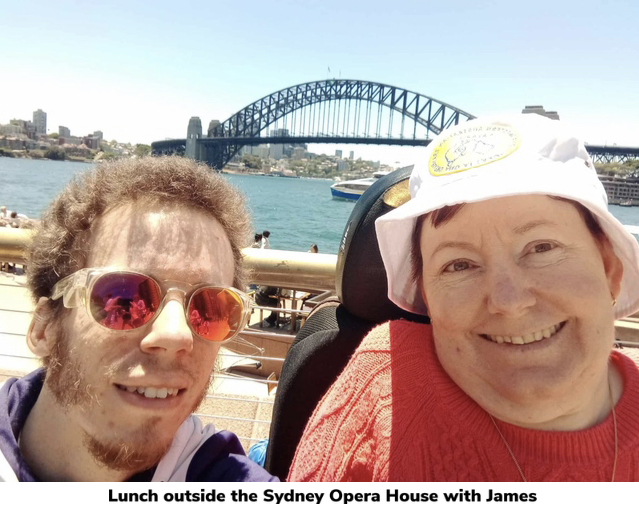
After lunch at Circular Quay, we did an accessible tour of the Sydney Opera House. It was nice to see behind the scenes, and the roof tiles up close. Our guide was knowledgeable and courteous of our needs.
When we arrived back at the hotel that night, the hoist was indeed there, and fit under the bed with the blocks I’d brought. But the carpet was very plush, and took a lot of strength to push it in our room. Why do accessible hotel rooms have carpet? It would make life easier if they had a hard floor covering instead, with the option of a rug if people required it.
The next morning we got up and had a shower. It was easier to leave the hoist in one position and bring the chairs to me. The hoist plus my weight made it tricky to move with me in it over the thick carpet. Of course we had to move it from the bed, but once clear, we left it in place. I was lowered onto my shower chair (I brought my own) and had a nice shower (although there was a large leak coming from the hose. While rinsing my hair it was washing my face at the same time!).
When it came time to transfer from the shower chair to my wheelchair, we hoisted up to the maximum height (which wasn’t very high). After changing chairs beneath me, I was lowered. We detached the sling, and pressed the up button. Nothing happened. It wouldn’t go up to make space for me to reverse. It would only go down.
I managed to back away, and plugged the hoist in, thinking it had a flat battery. Ten minutes later we tried again, but no change. At least I’d had a shower and got dressed and was in my chair before it broke down. I called John from the day before and told him about the issue. He said he’d send someone and report back later today. We left it at reception and headed for Taronga Zoo.
I’d forgotten how hilly the zoo was. In some places there were gentle slopes, but steep slopes in other locations. I’m glad I’m in a power wheelchair as manual chair users would have trouble. The zoo does have access maps, so is possible to plan your trip.
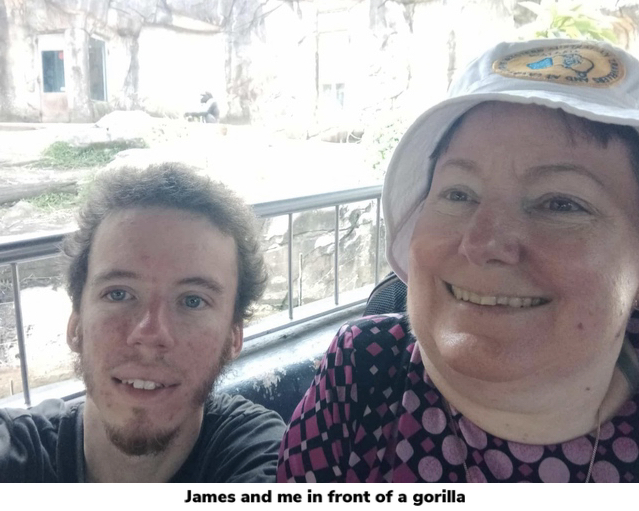
One of their lifts was out of service, so to get back up from one area, we had to go back all the way we’d come. Everyone else could go straight up the escalator instead. The views from some parts of the zoo are spectacular, and we saw plenty of animals.
John called me back to say they sent someone to check my hoist, but is in working order. They couldn’t find a fault with it, apparently. Very strange.
The bus drivers we had that day were kind enough to let us on without paying. I informed the drivers that we have electric ramps on our buses in Perth. They sounded annoyed that they had to fold the ramp out manually. I was impressed there was a seatbelt for wheelchair passengers to use, and I probably should have. Those roads are so bumpy and have I mentioned how hilly Sydney is? My wheelchair slid a few times.

The next day we had the same issue with the hoist not going up again. Instead of calling them, I asked Gen to lower it all the way to the bottom. Sure enough, it then went up again. I’ve never had this issue with a hoist before. We made sure we never went to the maximum height after that, and didn’t have another problem with it.
The wedding was held at the National Art School in Darlinghurst. It was beautiful. A real party. But no accessible toilet. After 5 glasses of champagne, it was almost midnight, so I decided to call it a night. I went back to the hotel to use our accessible toilet. It was a shame that I couldn’t stay on, and party until the sun came up like my brother did with half the guests. But I still had fun.
On our last full day there, we decided to go to Manly on the ferry in the afternoon. But first, lunch. Some locals raved about a ramen shop nearby that we were keen to try. We ran out with 30 minutes before their kitchen closed, only to find they had a big step out the front. We were so looking forward to ramen, but had to settle for burgers down the road as they had access. It wasn’t fair.
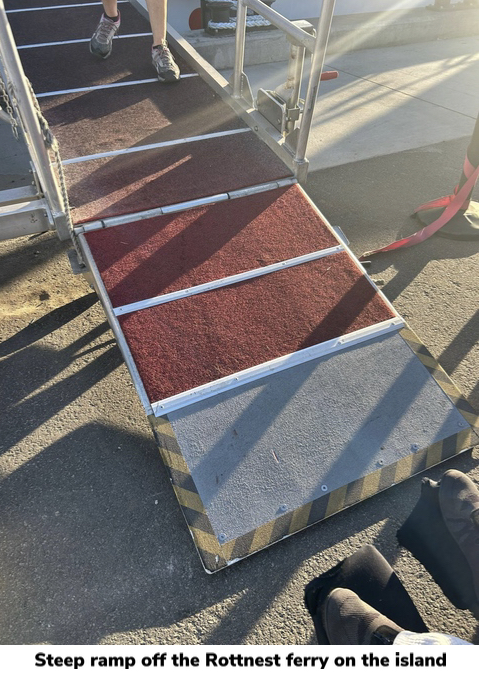
The Manly ferry was nice, once I got over the shock of the gangway. It was steep. Going up is easier for me than down, so I got on without much trouble. I was hoping we’d come back to a different pier; one where it was less steep. My heart sank when we weren’t.
“Wait until everyone else is off, please,” the ferry worker told me. I was preoccupied with the steepness of the slope that I failed to notice how close the fence was to the end of the gangway. I wasn’t going to be able to turn as soon as I was down and I would probably hit the fence.
As soon as everyone else was off, they moved the gangway so that it was no longer on a 90° angle with the ferry. It looked very dangerous being on a more acute angle. They reassured me that it was safe enough for me to go down. I tilted my chair back, James jumped on the back of my chair so he could hold on to my shoulders and keep my balance, and we went down very carefully with my heart in my chest. It felt like a miracle that I made it off the ferry in one piece, and didn’t crash into that fence.
I was so stressed about getting off that ferry safely that I forgot to get a video or a photo. How they can justify that it meets disability standards is beyond my belief. I recently travelled to Rottnest by ferry, and also had issues with the steep ramp getting off.
As much as I enjoyed my time away, I looked forward to coming home. But it wasn’t before more dramas with the Eagle Lift breaking down at Sydney airport before boarding our flight. Luckily, they had a spare, and it was brought out to assist me all the way to my seat on the plane.
Sydney is a very pretty city, but for anyone in a wheelchair, it’s a tough place to navigate. There’s no place like home, and I was very grateful to be back in my own bed, with equipment that worked, cheaper taxis, and in an easier city to navigate on six wheels.
On behalf of the PDA staff and Board, I’d like to say Merry Christmas or Happy Holidays (both are good) to all those who have supported PDA throughout 2025, those who have worked alongside us towards our cause for better human rights, improved participation and less discrimination for those of us living with a physical disability, our families and friends.
We may not shout the work that we do from the roof tops or seek recognition or acknowledgement for our efforts but that does not lessen the importance or significance of what we do.
To our members, thank you for believing in us.
We look to 2026 knowing that we still have work to do.
We will do this work with humility and understand the privilege bestowed on us in our roles.
Merry Christmas to one and to all.
Jeremy Muir
On Sunday February 1st 2026, Physical Disability Australia (PDA) will be hosting the fourth Physical Disability Awareness Day.
Established by PDA in 2023 after seeing a gap in the awareness calendar for highlighting physical disabilities, this very special day brings attention to people living with physical disability, their contributions and the many conditions that fall under the physical disability umbrella.
The day also provides a wonderful opportunity for people to come together and be united in their support for Australia’s physical disability community.
The ever popular online DisabiliTEA event will once be held, this time with a fun disability themed Bingo session (with some fantastic prizes) and some amazing guest speakers who will share their stories.
The Bingo host and caller will be Robert Wise, Physical Disability Awareness Day Committee member and PDA Board representative.
NSW/VIC/ACT/TAS 2pm
SA: 1.30pm
QLD: 1pm
NT: 12.30pm
WA: 11am
Feel free to pour yourself a cold drink or make yourself a cuppa as you enjoy a fun line up of guests and fun disability themed bingo games.
To register for the online DisabiliTEA event, please go to https://us02web.zoom.us/meeting/register/q3wGsKsUSga_rmddVY_lmw
GROUP EVENT REGISTRATIONS – Registered DisabiliTEA individuals running group events with 4 or more registered attendees who actually show up, will go into the draw to win a $100 Prezzee gift card to be divided/distributed by winning registered host at the discretion of those attending the winning group event.
We look forward to having you join us to celebrate Physical Disability Awareness Day 2026.
Together let’s grow and strengthen Physical Disability Awareness Day by making some noise, being seen, being recognised, being considered and being celebrated.
For news and updates on what’s happening near you and how you can be involved, please email promotion@pda.org.au.
If you would like to run your own Physical Disability Awareness Day event or would like to be involved in the organising committee for next year, please email Natasha Nobay (Communications and Engagement Manager, Physical Disability Australia) at promotion@pda.org.au or call 1800 732 674.
IMAGE: The Physical Disability Awareness Day logo is made up of many diamond/square shaped leaves made up of the colours of the rainbow. Over the top of this sits the words “Physical Disability Awareness Day” in white text. The inclusion of many colours within the logo represent the many different physical disabilities, encapsulated in the purple associated with disability representation. The leaves (squares) pointing inwards within the overall image signify the unity and support within the physical disability community and wider public, and the pointing out of leaves symbolise the need to raise awareness and to increase support, inclusion and acceptance moving forwards.
PDA’s Board and Staff wish everyone a very Merry Christmas and a New Year full of happiness, wonderful memories, good health and great times.
 1800 732 674


