She shares her take on the day below:
Yesterday, on a day that was as bleak as the future we are facing under the NDIS reforms, sitting in Parliament House meeting room S2.1, Paul Williamson (Physical Disability Australia Ltd (PDA) President) and I watched the tide of opinion around the NDIS reforms swell into something far greater than a debate. It became a tsunami. For hours, the message had rolled in like relentless waves: yes, we all agreed the NDIS needed to be sustainable, and yes, reform was necessary, but this Bill carried serious consequences and deserved proper consultation before it was forced through. Organisations had poured their concerns into submissions; then some spoke to the committee while others walked the corridors of Parliament House, knocking on doors, making calls, and fighting for change via any opportunity that raised its head.
Then a panel of four people with lived experience took the stage, and everything shifted. Their stories crashed over the room, turning those steady lapping waves into a forceful swell that struck ministers and audience alike with the raw truth of what it means to live with disability, or to care for someone who does.
And then came the tsunami.
Hannah Diviney took her place at the table and spoke with passion, humour, sarcasm, and gravity. With devastating clarity, she swept away the arguments for rushing the Bill through, exposing the potential consequences and placing responsibility squarely where it belonged: on the people prepared to pass this Bill at speed, unaware, or ignorant of, the damage it may cause.
In a room where visitors tiptoed in and out, where every voice was lowered to a whisper, we ignored the risk of being ushered out and clapped as loudly as we could. And in that moment, hope arrived. Because perhaps, just perhaps, consultation will come before the Bill is signed off.
While acknowledging the life-changing support he has received through the NDIS, Dinesh also expressed concern that people with disability – the very people the Scheme exists to support – are too often excluded from the conversations and legislative decisions that directly affect their lives.
As Dinesh said, the person with disability must remain at the centre of the Scheme.
Listen to his powerful contribution to the hearing here:
Dinesh begins speaking at 2:38:13.
A plain-language look at why everyday access, safety, and inclusion still matter – and why your voice does too.
What does progress mean if you still cannot get into your home easily, catch public transport with confidence, or feel safe in the support systems meant to protect you? That is the heart of this latest disability update. Behind the policy language is a much more personal truth: for many people with physical disability, everyday life is still shaped by barriers that should not be there.
What the update is really saying
One of the most important ideas behind the Strategy is this: disability is not just about a person’s body. It is also about the barriers around them. And for many people, those barriers are everywhere — in housing, transport, support systems, and the way society responds. That is why this update matters. It reflects the gap between what inclusion should look like and what daily life can actually feel like.
What is getting better
There are some signs of progress, and that matters. Some people are finding it easier to access government buildings and other facilities. That might sound basic, but physical access changes everything. It can mean more independence, more confidence, and fewer exhausting workarounds just to get through the day.
There has also been a small improvement in self-advocacy among NDIS participants. In other words, more people feel able to speak up for themselves, ask for what they need, and have their voice heard. That is important, because no one should have to fight so hard just to be included.
There has also been a small lift in enjoyable activities for some NDIS participants. That may seem like a small thing on paper, but it is not small in real life. More choice, more connection, and more moments of joy all matter.
What is not improving fast enough
Housing is still one of the biggest pressure points. If you cannot find an accessible, affordable, secure place to live, everything else becomes harder. Work, study, rest, routines, and independence all depend on that foundation. Right now, the update suggests that too many people are still being left to wait.
Transport is another daily barrier. Even when a workplace, clinic, or community space is technically accessible, getting there can still be the hardest part. And when transport does not work, it is not just inconvenient. It limits freedom, opportunity, and participation.
The update also shows that social participation has gone backwards. That is a reminder that inclusion is about more than being able to enter a building. It is about being part of your community, your workplace, your friendships, and everyday life.
Safety is still a serious issue. Complaints about abuse and neglect in the NDIS have risen sharply, and that is deeply concerning. People with disability should not have to choose between support and safety. They deserve both, without compromise.
There are also signs that discrimination is not being handled well enough. When rights are ignored and complaints are not taken seriously, people are left carrying the burden. That should never be the expectation.
That matters because real inclusion is not just about access. It is also about being respected, protected, and backed by systems that actually work when you need them.
Why housing and transport matter so much
For many people with physical disability, housing is the foundation for everything else. If your home is not accessible, affordable, or secure, it becomes much harder to live independently. The update suggests Australia still has a long way to go in this area.
Transport matters just as much. Even if a workplace, clinic, or community venue is accessible, getting there can still be the hardest part. When transport does not work, people miss out on opportunities and everyday freedom.
Safety, rights, and respect
The update also highlights something deeper than access: safety and dignity. People with disability are still more likely to face violence, abuse, neglect, and discrimination than people without disability. That shows inclusion is not only about ramps and lifts. It is also about rights, respect, and systems that respond properly when something goes wrong.
The bottom line
So yes, there is progress here. But it is uneven, and for many people it will not feel fast enough. The real test is not whether change is happening somewhere. It is whether people with physical disability can actually feel that change in their homes, their travel, their safety, and their everyday lives.
Why this matters for people with physical disability
If you live with physical disability, none of this is abstract. These issues shape real days, real choices, and real opportunities. And that is exactly why this conversation matters. Access is not a bonus. Safety is not a bonus. Inclusion is not a bonus. They are part of living with dignity. This update is a reminder that progress is possible, but it also shows why people with disability must keep being heard, believed, and centred in every decision that affects their lives.
If this feels familiar, you are not alone. Your story matters, and it deserves to be heard.
If you want to share your experience of housing, transport, access, safety, or everyday life with physical disability, send your story to promotion@pda.org.au. If you have a photo that can also be used to explain your concern, please feel free to add that too.
If you would prefer your name to remain confidential, please let us know.
Real change starts when real voices are listened to.
Drawing on responses from 798 Australians affected by partner income testing over a two-week survey period, the report reveals that this policy is far more than an administrative Centrelink measure.
Respondents described experiences of financial dependency, hardship, fear of disclosure, relationship strain, and safety concerns – highlighting the significant personal impact of a system that can create barriers for those who genuinely need support.
Findings included:
Sophia’s report makes an evidence-based recommendation to abolish the Partner Income Test across affected Centrelink payments and assess adults as financially independent individuals, regardless of their relationship status.
To read the report, go to:
If you would like to share your stories around this topic, please leave a comment or email us at promotion@pda.org.au.
A relationship should not come at the cost of financial independence.
This blog was prompted by a loose discussion within the PDA Board about our experiences travelling abroad. After hearing some truly horrific stories from some of our members, I volunteered to try a lighter tone and share some history about how I used a bit of lateral thinking to enjoy a much better time than my early efforts.
Many years ago, I dropped in on my sister Sally’s apartment in East Melbourne to find her hosting drinks for friends just returned from a month in Jamaica. I quickly gathered the champagne had already been flowing for some time and listened in to stories about the girls meeting seven-foot West Indian men through a new dating app called Tinder.
What is Tinder, I hear you say? In short, it’s an early 2010’s dating app that helps singles connect by the sharing of photos and two-sentence introductions. Users scroll through the photos of prospective dates, swiping right to indicate interest and hoping that one will receive a right swipe in return. This then enables an online conversation within the safety of the app that can eventually lead to a hook up in the real physical world. Love Story it is not.
And how might this Tinder app assist a young man with disability travelling abroad? Not at all in the beginning, as it happens. When I first downloaded the app ahead of a four-week trip to Paris, London and New York, I found it was completely inaccessible to a blind person such as myself. I obviously couldn’t see the picks, but the app also had problems preventing me from swiping left or right, sending texts and the like.
I reported this to the Tinder designers and was somewhat surprised when they replied immediately seeking assistance fixing the app. I continued to test it for them as I passed through Paris, London and New York. By the time I was sitting in JFK Airport waiting for my flight home, I was able to start getting matches and receiving requests for a date. Encouraging…
Later the same year, I was back in an airport lounge starting a trip to Argentina. Ahead of boarding, I turned Tinder on, set my location to Buenos Aires and published a two-sentence description of myself as a blind Australian in town for three weeks seeking dates with local women willing to show me around their city.
The results were nothing short of amazing. By the time I arrived in Buenos Aires, I had scores of matches on Tinder and a full schedule of dates. Within 48 hours, I’d been taken for cake by a Norwegian equestrian athlete, on a tour of a wooden sailing vessel by a woman who worked for the Argentine foreign office and on a series of walking tours by Veronica, a puppeteer from the local version of the Mr Squiggle television program.
It made for a much better holiday than might otherwise be the case. When I got off my plane at the airport, I was advised that no sighted guide service was available and I would need to navigate my own way through border control. I had over-estimated how much English is spoken in Argentina – the Falklands War might have been a hint – and there’s a good chance I’d still be lost in that airport now if not for the assistance of a university student in a wheelchair who warned me that accessibility in Latin America is not the same as what I’m used to at home. Little did she know I had a cunning plan to overcome any anticipated barriers.
With the help of Veronica, I was able to explore a foreign city to a depth and diversity that I’d never been able to do before. We covered everything from grand Cathedrals, the sites of famous riots and gigs in back street bars by Spanish-speaking Nick Cave clones. True to the legends of passionate South Americans, she wept when it all came to an end and I headed back home a few weeks later.
I should say that Tinder is now all ancient history for me. I don’t even know if it still exists. My 132nd Tinder date was with Jane, my current partner and mother of our 9-year-old daughter Josie. Our foreign holidays are now largely confined to the comfort and reliability of beachside resorts. It’s nice – but not quite the grand adventure that this disabled man enjoyed back in the day.
Written by Sean Tyrell, PDA Associate Director Victoria
Many PDA members are aware that the Parliament has passed legislative amendments intended to make it easier for victims of sexual harassment, discrimination and victimisation to enforce our rights in the Federal Court. The law has been changed so that the payment of legal costs no longer follows the outcome of a case.
For many decades, the prospect of paying the other side’s legal costs if I lost a disability discrimination case deterred me from going any further than alternative dispute resolution. But over the past few months, I have gone forward with an application to the Federal Court for an Order declaring that the National Disability Insurance Agency contravened the Disability Discrimination Act by failing to make the reasonable adjustment of providing correspondence in accessible format. The PDA membership is perhaps one of the few audiences who won’t be surprised that I’m one of many blind NDIS Participants who gets sent his Plans and other vital information in print – despite my years of asking for it in a format I can actually read.
My reflections on how the cost protection amendments have changed things are mixed.
First, I’ve certainly found it true that Parliament limiting the other side’s threat to seek a costs order against me has significantly levelled the playing field. It has both made me a lot bolder in advocating for fair treatment while simultaneously focussing the other side on the need to resolve matters without a trial.
Second, it is early days and the impact of the costs protections amendments is still filtering through legal professionals. I’ve been advised that so far no one has asked a Judge to apply the new laws, and everyone is therefore waiting for someone else to go first. As a result, barristers are taking a careful line and advising clients to proceed with caution.
Third, as good as the cost protection amendments are they are not a silver bullet for overcoming the deeper problems with the Disability Discrimination Act 1992 and Australia’s other rights protection statutes. This might mean that all the Parliament has really done is make it easier for people with a disability to lose test cases that our community might assume we would win. While for many years I’ve listened to lawyers warn me about the dangers of an adverse costs order, I’m now hearing warnings that the definitions of direct and indirect disability discrimination are so narrow that it makes it virtually impossible to win.
Fourth and final – and somewhat contrary to all the above – the Court itself does give off a strong vibe that it wants to get more active in protecting the rights of Australians with a disability. To my utter amazement, within just a few weeks of me lodging my application I got a call from the Judge’s office advising he wanted to start hearing the case as soon as possible. A month or two after that the Court doubled down by connecting me with pro bono lawyers from a large and formidable firm. I’m also hearing reports that some Judges and Court employees have been undertaking disability confidence training.
In the end, the proof will be in the pudding. While there’s certainly been useful cases since Parliament passed the Disability Discrimination Act 1992, I think it’s fair to say physical disability is still waiting for our Mabo or Richardson v Oracle. Let’s see which member of our PDA community will be first to pick up a hammer and swing it with all her might.
I went to Sydney for my brother’s wedding in November 2025. My airfares and hotel were booked back in June, so I could relax and wait for my trip to happen. Or so I thought.
This was my first trip on a plane with my boyfriend James, and his first time to Sydney (my fourth trip there, I think). I was relaxed, but James was getting stressed leading up to the trip. He’s autistic, and I was putting him in a situation he’d never been in before. It was bound to overwhelm him at some stage. My support worker Gen also came with us.
We wrote lists of what to pack, and triple checked them before zipping our suitcases shut. My mum dropped us all off at the airport (six minutes is how quick you have to be to not be charged. When you have 3 people, 3 suitcases, and a wheelchair to offload, there should be some leniency. But Mum was quick enough to get out for free!).
James wanted to be there super early. We ignored the prior messages from Qantas about online check-in and made our way to the special assistance desk. We handed over our luggage, got tags on my wheelchair and answered 100 questions about its size and weight.
By the time we got through security (and my pat down), ate lunch, and went to the toilet, it was time to be at the gate. I’d told Qantas when I booked in June that I’d need the Eagle Lift to get to my seat. They had it, but brought it out at the last minute. As I drove underneath it to be hoisted up out of my chair, they had trouble making it wide enough to fit easily. It should have been a red flag.
They brought me into the plane and then realised the sides weren’t able to come in again. They were stuck in a wide position. This would not do to get me onto my seat as it needed to be adjustable to go between the rows of seats in economy. I was hanging around in the doorway of the plane while they figured out a plan B. The staff were getting quite stressed and embarrassed by this malfunction of the lift. The plane had already been delayed an hour, so what was another few minutes? I was happy to hang around in the doorway.
I asked if they had an aisle chair nearby. Up and down on the lift still worked, so I suggested they go find one. They did, so they lowered me on to that, removed the Eagle Lift from the plane, and wheeled me down to my seat. James and another crew member managed to lift me on to my seat. Just a bit of drama to start our holiday. I hoped it wasn’t an omen for what was to come.
We had an enjoyable flight, and my wheelchair made it in one piece. It was after 11pm when we lined up for a taxi. We didn’t have to wait too long before a maxi taxi came. 22 minutes later we were at our hotel, but it cost $80! I couldn’t believe how expensive it was. My interstate voucher has a value of $25, so I had to pay $55. I was paying cash but the driver didn’t offer a discount. We took a while to get the correct change, which he didn’t appreciate, and he took off in a huff. I found out later that the NSW Government pays drivers $27.50 every time they take a local wheelchair user (a lift fee). But not when you’re from interstate, so I had to bear that cost. That’s why it was expensive for a short trip. Why isn’t it the same across Australia? If only Ubers took wheelchairs in specialised vehicles…
We checked into the Adge Hotel in Surry Hills. But when we got to our room, there was no hoist. I’d booked Independent Living Specialists to deliver a full hoist with pivot frame that day. We made a call to reception but they didn’t know anything about it. James was able to lift me from my chair into bed, but we’d need it in the morning to get me up safely. We set our alarm for 8am and fell asleep.
We called ILS just after 8am but they didn’t open until 9am. We finally had a call from John at the warehouse around 10am, He was furious that the delivery man tasked with dropping off my hoist the day before didn’t do it, nor told anyone that he hadn’t. So John was going to come himself, but not until after midday. This was the first day of our holiday. I didn’t want to spend most of it in bed. Plus I was hungry. The meal on the plane hadn’t filled me up.
So I decided to skip a shower, and get dressed in bed. Gen and James were able to top and tail me, and lifted me back into my chair. It sure beat waiting for the hoist to arrive.
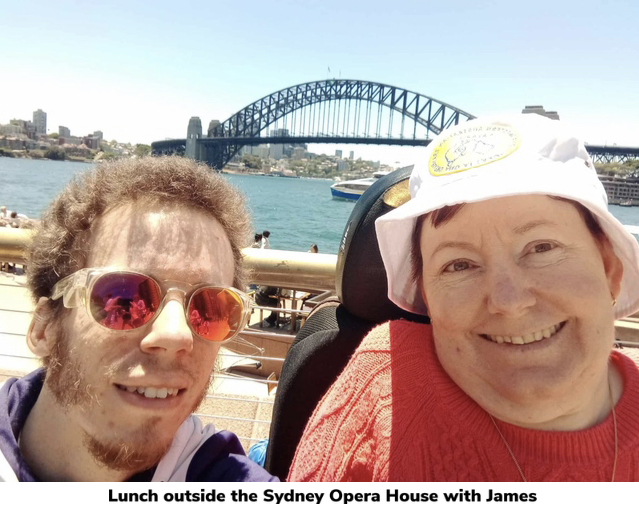
John called us before 12:30pm to say he was there. We had already left and were on our way to Circular Quay to show James the iconic sites. I forgot how hilly Sydney was, and how steep ramps can be. It was lucky that James rides on the back of my chair as he was able to hold my shoulders while going down slopes. My balance isn’t great, so it was nice having James support me. The alternative is to tilt my chair back every time I went down steep ramps. That would take too long each time and I’d be late everywhere. Even with my footplates elevated, I still scraped the bottom on some ramps.
After lunch at Circular Quay, we did an accessible tour of the Sydney Opera House. It was nice to see behind the scenes, and the roof tiles up close. Our guide was knowledgeable and courteous of our needs.
When we arrived back at the hotel that night, the hoist was indeed there, and fit under the bed with the blocks I’d brought. But the carpet was very plush, and took a lot of strength to push it in our room. Why do accessible hotel rooms have carpet? It would make life easier if they had a hard floor covering instead, with the option of a rug if people required it.
The next morning we got up and had a shower. It was easier to leave the hoist in one position and bring the chairs to me. The hoist plus my weight made it tricky to move with me in it over the thick carpet. Of course we had to move it from the bed, but once clear, we left it in place. I was lowered onto my shower chair (I brought my own) and had a nice shower (although there was a large leak coming from the hose. While rinsing my hair it was washing my face at the same time!).
When it came time to transfer from the shower chair to my wheelchair, we hoisted up to the maximum height (which wasn’t very high). After changing chairs beneath me, I was lowered. We detached the sling, and pressed the up button. Nothing happened. It wouldn’t go up to make space for me to reverse. It would only go down.
I managed to back away, and plugged the hoist in, thinking it had a flat battery. Ten minutes later we tried again, but no change. At least I’d had a shower and got dressed and was in my chair before it broke down. I called John from the day before and told him about the issue. He said he’d send someone and report back later today. We left it at reception and headed for Taronga Zoo.
I’d forgotten how hilly the zoo was. In some places there were gentle slopes, but steep slopes in other locations. I’m glad I’m in a power wheelchair as manual chair users would have trouble. The zoo does have access maps, so is possible to plan your trip.
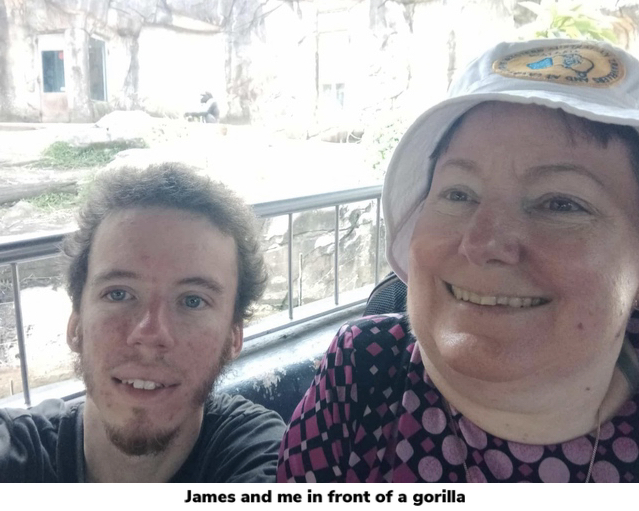
One of their lifts was out of service, so to get back up from one area, we had to go back all the way we’d come. Everyone else could go straight up the escalator instead. The views from some parts of the zoo are spectacular, and we saw plenty of animals.
John called me back to say they sent someone to check my hoist, but is in working order. They couldn’t find a fault with it, apparently. Very strange.
The bus drivers we had that day were kind enough to let us on without paying. I informed the drivers that we have electric ramps on our buses in Perth. They sounded annoyed that they had to fold the ramp out manually. I was impressed there was a seatbelt for wheelchair passengers to use, and I probably should have. Those roads are so bumpy and have I mentioned how hilly Sydney is? My wheelchair slid a few times.

The next day we had the same issue with the hoist not going up again. Instead of calling them, I asked Gen to lower it all the way to the bottom. Sure enough, it then went up again. I’ve never had this issue with a hoist before. We made sure we never went to the maximum height after that, and didn’t have another problem with it.
The wedding was held at the National Art School in Darlinghurst. It was beautiful. A real party. But no accessible toilet. After 5 glasses of champagne, it was almost midnight, so I decided to call it a night. I went back to the hotel to use our accessible toilet. It was a shame that I couldn’t stay on, and party until the sun came up like my brother did with half the guests. But I still had fun.
On our last full day there, we decided to go to Manly on the ferry in the afternoon. But first, lunch. Some locals raved about a ramen shop nearby that we were keen to try. We ran out with 30 minutes before their kitchen closed, only to find they had a big step out the front. We were so looking forward to ramen, but had to settle for burgers down the road as they had access. It wasn’t fair.
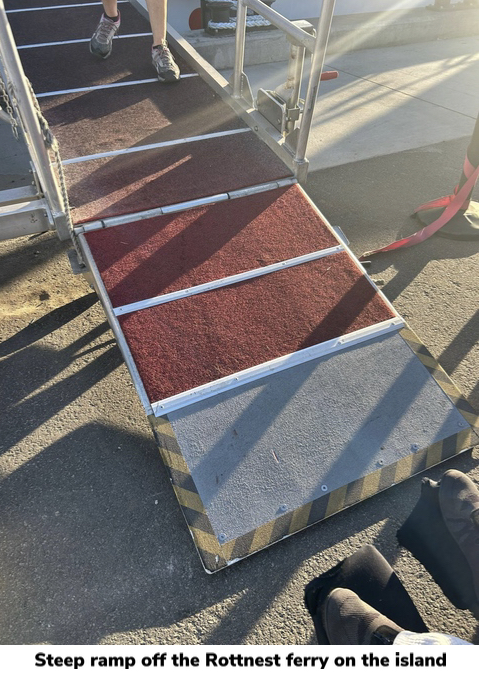
The Manly ferry was nice, once I got over the shock of the gangway. It was steep. Going up is easier for me than down, so I got on without much trouble. I was hoping we’d come back to a different pier; one where it was less steep. My heart sank when we weren’t.
“Wait until everyone else is off, please,” the ferry worker told me. I was preoccupied with the steepness of the slope that I failed to notice how close the fence was to the end of the gangway. I wasn’t going to be able to turn as soon as I was down and I would probably hit the fence.
As soon as everyone else was off, they moved the gangway so that it was no longer on a 90° angle with the ferry. It looked very dangerous being on a more acute angle. They reassured me that it was safe enough for me to go down. I tilted my chair back, James jumped on the back of my chair so he could hold on to my shoulders and keep my balance, and we went down very carefully with my heart in my chest. It felt like a miracle that I made it off the ferry in one piece, and didn’t crash into that fence.
I was so stressed about getting off that ferry safely that I forgot to get a video or a photo. How they can justify that it meets disability standards is beyond my belief. I recently travelled to Rottnest by ferry, and also had issues with the steep ramp getting off.
As much as I enjoyed my time away, I looked forward to coming home. But it wasn’t before more dramas with the Eagle Lift breaking down at Sydney airport before boarding our flight. Luckily, they had a spare, and it was brought out to assist me all the way to my seat on the plane.
Sydney is a very pretty city, but for anyone in a wheelchair, it’s a tough place to navigate. There’s no place like home, and I was very grateful to be back in my own bed, with equipment that worked, cheaper taxis, and in an easier city to navigate on six wheels.
Katherine Reed is an incredible woman and someone that we are proud to have involved with PDA as Tasmania’s Associate Director.
She has just had her story shared by the ABC.
A great read.
https://m.facebook.com/groups/physicaldisabilityaustralia/permalink/10162578990732599/?
Photo supplied by Basketball Victoria.
The elevator doors closed behind me, but it didn’t move.
Uh-oh, I thought. Now what?
In the 14 years I’d been a wheelchair user, I’d never been in a lift on my own before. But here I was, in my first semester of a Japanese Studies degree at Murdoch University, and needing to get to the second floor for a lecture on cross-cultural psychology. It was a very small lift in an old building at the opposite end to the lecture room. My arms weren’t long or straight enough to press the button to go up. I was stuck. For about an hour. And missed my lecture.
This was 1997, before everyone had a mobile phone, so I couldn’t even call for help. Eventually someone came to use the lift and found me – what a surprise they got. I was just relieved to be out of there. Lucky I don’t get claustrophobic.
That afternoon when my mum came to pick me up, I told her what had happened. “You need to carry a stick,” she said.
Being the practical person Mum is, we stopped at Bunnings on the way home. She bought me a wooden dowel, a pack of rubber stoppers that fit the end, and some plastic tubing. When we got home, she put a rubber stopper on one end of the dowel, cut some tubing and slid it over the other end, and gave it to me. Voila: my stick was born.
I put the plastic tubing end into my mouth and tested my stick on a light switch. Oh my goodness, it worked! For the first time in my 17 years, I could do things I’d never thought possible, like turn a light on or off. This would be the start of the independent life I’d craved. Thanks Mum!
But what else could I use it for? I looked around my room. If I hooked the little rubber stopper on my pencil tin on my desk, I – oh yes – I could bring it closer or push it out of my way. I learnt that I could also scratch my head, type on my computer and open and close doors. While I was living with my parents and three younger brothers, it hadn’t occurred to me that I’d need to be capable of doing these things for myself if I wanted to move out of home and not need 24-hour care.
The only challenge with my new stick was how to carry it? I’d need it at uni to press lift buttons, so I wouldn’t get stuck ever again. My stick might be small in diameter but was about a metre long. It was too big to carry on my tray.
My dad got to work in his shed. He was a boilermaker and had lots of tools at home. It didn’t take him long to develop a stick holder. Made from aluminium tubing, he blocked the bottom, and attached a bracket to screw to my leg rest. I now had a stick and could carry it everywhere I went. Thanks Dad!
I developed an independent spirit from that day. My parents had always encouraged me to do as much as I could for myself, while accepting help for the things I couldn’t. But with this stick, I could demonstrate it practically to others. I’m certain it helped me be accepted as an exchange student to Japan in 1999 for 10 months. I wasn’t taking no for an answer and was determined to fulfil my university studies degree by studying at a Japanese university.
The problem with wooden sticks is they broke often. And when overseas studying, it became an issue. We found a hardware / garden centre that had my stick replaced quickly, every time I broke it.
Once back in Perth, I graduated and had to find a job. I was invited to be a guest speaker at disability awareness training sessions for Main Roads staff. I always started my talk by showing my stick and asking what people thought it helps me with.
After one presentation, a man at the back put his hand up to ask me a question. “Why do you use a wooden stick? Have you ever used fibreglass sticks?”
I shook my head. During the morning tea break we chatted further. “We use them as flag poles for the orange flags at children’s school crossings,” he explained. “We often get them back a bit worn out. I could deliver some to you next week.”
Sure enough, the following week he delivered four to my door. They were slightly slimmer than the wooden ones I was used to, and a little heavier. I had to build my jaw muscles to be able to use it effectively, since I use it in my mouth for most things. It took me a while to get used to it, but I haven’t broken a stick since. I’m still using the original ones – for over 20 years now.
In 2015 I received my third assistance dog, Upton. He found my stick difficult to pick up off the floor. He couldn’t get his front teeth underneath it. “What if we added an elastic band?” his trainer asked me.
With the band in place, Upton learnt to target the band to pick it up every time. But I quickly found another use for it: tagging my Smartrider card on and off buses and trains. I always carried my card in a plastic pouch with a pipe cleaner handle, and dangled it from the end of my stick. But on buses, the tag-on machine is above my head height, so the pouch always slid and hit me in the face. The elastic band stops it sliding, and since then I haven’t had to ask other passengers to tag on for me. Thanks Upton!
In 2023 I was browsing social media when I saw a competition called the Simply Open Awards. They were looking for simple solutions and innovations that can help people with disabilities. I made a five-minute video about my stick. I explained why I needed it, how it was made, and demonstrated several uses around my home, from pressing light switches to sliding doors open and closed. I even showed how I can heat my leftover dinner in the microwave with the short stick I have.
One evening I received an email saying I was a prize-winner (a cash prize of £750), and my video had been sent to the judges at the Discovery Awards. The next night I received an email saying my video was voted the top two innovations IN THE WORLD, and my prize was a trip to Vienna to attend the Zero Project Conference in February 2024! All because of the video I made about my stick. The stick I carry everywhere because I was stuck in a lift and couldn’t reach the button. The same stick that has enabled me to catch public transport to work independently, and not need 24-hour care. It really did change my life.
PDA’s CEO, Jeremy Muir, was a recent guest on Navigating Disability’s popular podcast.
We admit to being a biased crew here in the PDA office, but we think this interview is so powerful and simply confirms our superfan view of Jeremy.
Interviewed by Kate Read and Jenn Abbott, this podcast explores Jeremy’s life both before and after acquiring his disability, where his life has taken him and how he came to a place where he is proud of what he’s achieved and who he has become.
It’s now available to view on YouTube (www.youtube.com/watch?v=oQK9C55JbI4) and is particularly relevant to share with you on #ruok day.
We encourage you to check it out.
“At just 19, Jeremy Muir’s life changed forever after a car accident left him with a spinal cord injury. But as Jeremy says, “Why not me?”, a question that became a driving force behind his journey of resilience, reflection, and radical independence.
In this powerful episode, Jeremy opens up about the mental, emotional, and physical challenges of adapting to life as a quadriplegic. From his early struggles with depression and suicidal thoughts, to building a fulfilling life filled with love, purpose, and advocacy, Jeremy’s story is both deeply human and extraordinarily hopeful.
We talk candidly about the gaps in mental health support, life before the NDIS, navigating relationships, and why disability must never be an afterthought in society. His reflections remind us that inclusion isn’t just a policy, it’s a mindset and a responsibility we all share.
⚠️ Trigger Warning: This episode discusses topics related to depression and suicide. If you or someone you know needs support, contact Lifeline at 13 11 14.
🎧 Join us for this emotionally rich episode that will leave you inspired to listen more, judge less, and advocate fiercely.”
 1800 732 674


