Tim Marks (PDA TAS Director) shares this video of his new leg being fitted.
It is a c leg computerised prosthetic leg with a flex foot. The socket is a varios socket which, at the time of recording, had only been out 8 months.
After 13 years as a wheelchair user, Tim is finally learning to walk again.
On Thursday 01 June I attended the Assistive Technology Suppliers Australia (ATSA) Independent Living Expo at the Perth Showgrounds.
I went to check out what is new and upcoming in the AT world. To be very honest, I have been to many of these in the past and so was not really expecting anything to take my breath away. Well, I was very wrong.
There were well over 100 suppliers. Everything from all types of wheelchairs and wheeled mobility devices to bedding, beds and lift chairs for the lounge to modified accessible vehicles, to the latest in devices for vision impaired people.
I want to highlight 3 products that really blew my mind.
#1. A remote-controlled wheelchair. I was wandering through the exhibits and this empty attendant wheelchair came towards me. It was surreal to see this, so I followed it to the stall to have a chat with the operator. She explained that it was designed for a user who needed to move the chair independently once they had transferred from the chair to a bed for example. It can be easily operated by a support worker or by the person with a disability.
#2. In the physical disability world, we know that on the whole wheelchairs haven’t really changed much in the past years. I came across Rove, an engineering company based in Melbourne, who are doing some game changing work in the build, and weight, of custom wheelchairs. They are building them with 3D printed Titanium, so they are super lightweight and extremely strong. As they are custom made, the final chair is completely custom fitted to the user and as they say, “millimetre perfect”. I was passed a very big frame and it weighed no more than my prosthetic leg. Incredible.
#3. Mobility scooters are great, except when you forget to charge the battery. Well, there is now a solution. A solar powered scooter. This scooter has 2 onboard batteries which are on constant trickle charge as the scooter is being used out and about. It has 3 solar panels on it which are flexible. It can also be plugged into mains power.
I would encourage all members to go to the ATSA Expo in your area. It not only is a great opportunity to see, touch, hold and explore new AT, but also to network, meet new people and catch up with old friends.
It was great to spend some time with my WA Associate Director, Melanie, and get some photos together.
Please check out the link below to see a short video of the remote-controlled wheelchair:
There’s nothing worse than being cold! I find it really difficult to warm up. I take at least 20 minutes to get dry and dressed after a shower and can’t wear thick jackets or extra layers as it affects my arm movements. I still need to be capable of driving my wheelchair and feeding myself on cold days. My hands and feet are like ice blocks most days. It makes me miserable, and I can’t sleep if I’m too cold. Nobody likes grumpy Mel, so here are my top tips for surviving winter:
#1 Heated throw rug – I got one last year from a friend, and I love it! I have it plugged into a smart Wi-Fi plug and use my voice to turn it on and off through my Google assistant. So handy when I go to bed freezing, or wake up shivering during the night. The smart plug app has built in timers, so I can set it to switch itself off. It usually only takes 15 minutes, so I warm up quickly. I wish I could hide under it all day!
#2 Bake – find any excuse to put the oven on! My favourite thing is to roast pumpkin. I take my time turning each piece over, enjoying the warmth on my face and hands. And always leave the oven open when you turn it off. It’s a great way to warm the house. Just be careful not to burn yourself.
#3 A warm bath – I love my bath! I have it as hot as I can tolerate. I got TADWA to make me a comfortable bath seat, and I have a wooden table for my magazine and a drink. And bath bombs are the best. The longest bath I’ve had was three hours, and yes, I had to add a kettle of boiling water after two hours as I started to get cold.
#4 Find the sun – my house was designed to maximise the winter sun. I go from window to window as the sun moves throughout the day.
#5 Hand warmers – I have an electric hand warmer that warms up to approximately 50°C, but I really like the Hot Hands hand warmers too. It is a lot lighter, they always come in sets of two, but unfortunately they aren’t reusable. Most chemists sell these, and they’re the only way my hands don’t freeze at the footy.
#6 Hairdryer – I always have cold hands while using my computer. So I put my hairdryer on my desk! I have it plugged into a wifi plug so I can turn it on and off with my phone. And it blows hot air right onto my hands! Great for when my support workers have freezing cold hands and they have to undress me. The only downside is it’s loud, so can’t use it during zoom meetings.
#7 Heated socks – yes they exist. I bought mine from Amazon. Mine have a pocket for the rechargeable battery to sit in while wearing. It has a remote control too! On the lowest setting the batteries last all day, and my feet are no longer purple ice blocks.

#8 Mulled wine – when all the above fails, mulled wine it is for me. I found Zenzen Gluhmein, a German Christmas wine, at Dan Murphys. A small amount in a mug in the microwave for a minute and I get toasty warm.
Good luck with keeping warm this winter!
***TRIGGER WARNING – LOSS AND GRIEF***
***SPOILER ALERT – “Guardians of the Galaxy 3”***
Today I went to a movie and I cried almost all the way through. This wasn’t some mushy romcom or chick flick. This was an action sci-fi film. It was “Guardians of The Galaxy 3”.
Why did I cry so much? I am a woman with a disability and the character Rocket brought out in me some deep-seated emotions around disability that just could not be held in. They burst forward and I was a blubbering mess for most of the film.
Rocket, like me, received many painful operations throughout his young life. These enhancements for both of us came at the cost of pain – real bone grating, breaking, aching pain. Seeing Rocket suffer triggered that empathy dam that burst its banks, allowing tears to roll forth in torrents. I know your pain Rocket!
The friends Rocket made in his cage caused all kinds of grief for me as well. This little creature was loved by his group of also tortured friends, with their shared pain and suffering creating a bond where together they endured and made the best of their sorry lives. When they were killed, that was it! I totally lost it. Rocket’s feelings of abandonment, pain and anger were so real and I felt that they were happening to me. Another creature misplaced in the universe.
As I write this, it’s 12 days ahead of the anniversary of Phil’s Death (my husband and partner of 33 years) and maybe this was the trigger that I needed to grieve again. It seems that loss is never finally over. When Rocket almost died, was reunited in the great hereafter and was told “we missed you, you can stay, but not yet as your time has not come”, again my tears rolled liked rushing snotty rivers down my face, with big ugly sobs to go with it.
Is death just the beginning? Will we be reunited with the ones we love? I hope so! And you know what? In the hereafter the movie characters still had their callipers and wheels, because they are part of what we/they are. We don’t have to change and be cured to accepted in the great beyond! We are what we are! LOVED!
I was not alone in my grief at this movie. My daughter beside me was just as stricken. We held hands and sobbed our way through the movie. Others probably thought we were an odd pair – the young woman and the older woman on a scooter crying uncontrollably at what is essential a children’s movie. We shared our grief together, separately, individual, but together in our journey of grief.
When the Guardian rescued the inhabitants of the factory of misery, and all the higher order creatures, the sobbing began again in earnest because creatures like Rocket were not included. Rocket would not leave them and the baby rockets were scooped up and hauled on his back to be carried through the fire and destruction and saved. Rocket risked his life to save them because in his eyes they were worth saving. They were his family. They were like him and worth life.
They had value. Wow, did that bring up deep seeded feelings of unworthiness that have personally followed me through life because of my disability. But I too am worthy and I applauded Rocket for his bravery in saving them. Who decides who is of value? Who decides who is worthy? Who decides who lives or dies? We judge a society on how it treats its most vulnerable.
I see myself in Rocket. and what I saw made me cry uncontrollably and think I would never leave this grief behind. It is now 5 hours later and I just had to write about this, to share how for me life imitates art. For me grief is still with me and like Rocket I will fight on. I will put my tears away, bolster my courage and, just like Rocket, live because I am worthy!
As a woman with a physical disability since the age of two, I never thought I was worthy of a man’s desires, or capable of fun times in the bedroom. With high needs in daily personal care tasks like toileting, dressing and showering, sexual matters never crossed my mind. What kind of man would choose me over an able-bodied person? They would be crazy to take on someone with additional needs.
Then in December I got Covid-19. I actually thought it would kill me, as I only have about 20% lung capacity. This is because I have a severe scoliosis and reduced muscle strength to cough. A simple chest infection can mean a hospital stay.
Two days before testing positive, I found out I was eligible for antiviral medication. So I was able to get them which meant that my symptoms were mild and only lasted three days. But it was during my isolation that I had a surprising conversation with one my support workers that changed my life. She told me about disability sex workers. I’d never heard of them, and didn’t even know it was legal here in WA.
In January 2023, at the age of 43, I had my first session with a male escort called Chayse. It was the first time I had been naked in front of a man, outside a hospital. A nerve-wracking experience, but Chayse made me feel comfortable and relaxed as he gave me an erotic massage at his place.
I felt out of my depths in terms of sexual knowledge, and didn’t even know that women masturbate (I thought it was something only men did). But what I didn’t know about sex, Chayse didn’t know about disability. We had a lot we could teach each other.
Unfortunately I didn’t get a ‘happy ending’ during the massage, but it wasn’t through lack of effort by Chayse. I booked him again for a second session, two weeks after the first. This time he came to my house.
I was more relaxed than the first session and I had paid for a mix of massage and escort. I had emailed him my list of fantasies: things I wanted to experience with a man. Top of my list was kissing, as I had never been kissed before and had no idea how to. Chayse was a good teacher and he didn’t disappoint. The three hours together flew by. I’ve seen him five more times since.
What I love most about Chayse is the way he makes me feel. He sees me as a woman first, with the same wants, needs and desires as any other woman. My disability becomes irrelevant. Sure we need to do some things differently, but it isn’t a barrier to accessing physical touch or intimacy or pleasure.

It is also a very safe way to explore sexual matters. By paying for the service, I have felt in control. If Chayse did something I didn’t like or made me feel uncomfortable, I trusted him to stop. I am immobile when in bed. It’s not like I can get up and walk away; a vulnerable situation to get myself into. But by paying a professional (a ‘sexpert’ as he calls himself), I maintain control. It is in Chayse’s best interest to do the right thing and satisfy his customers, or I won’t book him again. It’s no different to seeing an OT for equipment advice or a physio for aches and pains.
Chayse is very body positive and I have learnt from him that every body is beautiful, even mine. It was just after our second session that I got more comfortable telling people about him. I actually wanted to tell the whole world what an amazing service it is, how it has given me a new sense of worth, increased my confidence and made me feel amazing. But I was scared of people’s reactions.
The more people I told, the more positive reactions I received. They were really happy for me, and could see it made me happy. So I emailed the Deputy Editor at Take 5 magazine with my story idea about using escorts.
She loved the idea straight away. But I had to decide whether I wanted to reveal my identity, change my name or show my face in photos.
It wasn’t an easy decision, but again I had the support of family, friends, and of course Chayse. The key message I wanted to convey through the story is sexual health is a basic human right, according to the World Health Organisation. Just because I have a physical disability doesn’t mean I don’t deserve intimacy and pleasure. I’m not ashamed of wanting it for myself, only that I didn’t start many years ago.
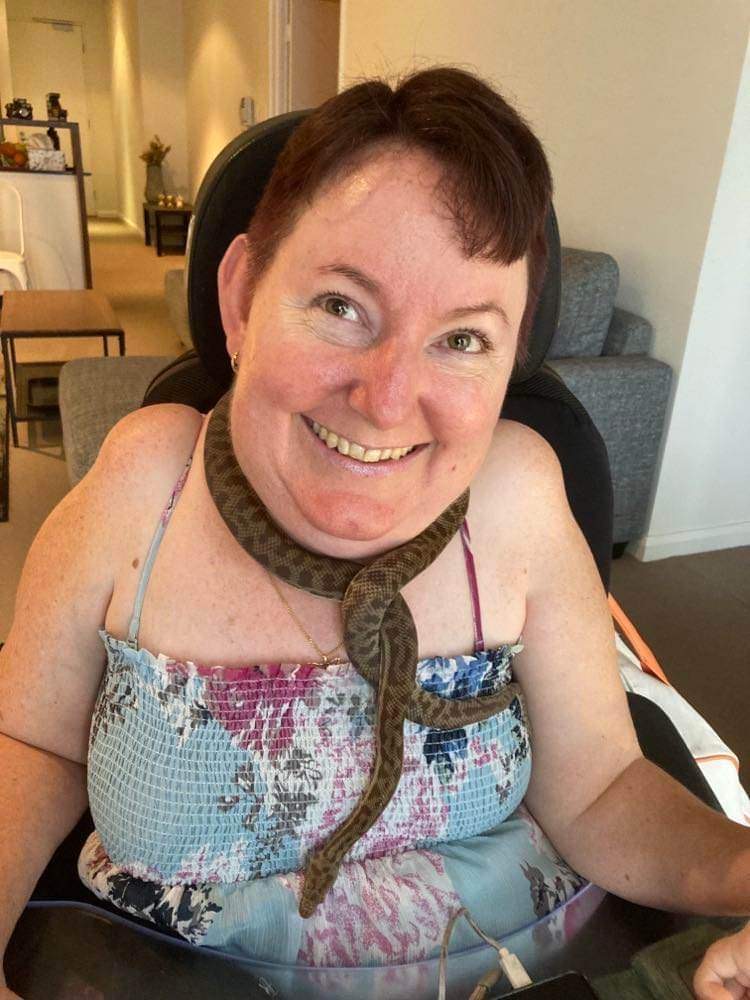
I’m speaking out and sharing my story now in the hope that others with disabilities realise they too can have it. The hours I’ve spent with Chayse have been some of my happiest. We’ve slow danced, had baths together, slept together, been swinging, I even rode in his V8 ute! I’ve bought lingerie and toys for the first time in my life. It has opened up a whole new world for me that I never thought I belonged to. These are opportunities I’d never thought possible, and I want other people to have their own fantasies realised.
I self-funded the first four sessions, and claimed the last three on NDIS. Check with your LAC to see if you can too. I self manage my funds, but believe the NDIS should see escorts as an essential service and fund it adequately. Relationships are tricky enough for able-bodied people. For some people with disabilities, escorts are the only way we can have a safe, positive sexual experience. Why deny someone that because of cost? It’s an activity those without disabilities take for granted.
I must thank those who have spoken out before me, who gave me the confidence to do the same. Amy Calladine wrote about her experience on MamaMia, Hannah Diviney spoke about acting on The Latecomers on the ListenAble podcast, and TV shows like The Swiping Game and Better Date Than Never have made talking about sex more mainstream and acceptable.
So what’s in store for me in the future? I have been blown away by the response of my Take 5 story since it was shared on news.com.au. I’ve had messages from journalists from as far away as Norway and the UK asking to interview me. And I’ve loved all the comments on Facebook and messages from strangers thanking me for my story. It’s obviously an important topic that not many are happy to discuss. I wasn’t prepared for my personal story to be popular worldwide, and I haven’t decided if I want it to be world news!
For now, Chayse has given me the skills, knowledge and confidence to put myself out there. He is helping me to navigate the field of online dating as a pathway to meeting a potential partner.
But if I have no luck, I’ll be asking the NDIS for a bigger budget next year.

Today I caught a bus. So what’s so unusual about that you ask, when millions of people all around the world do it everyday!
What makes it unusual is that I was able to catch a bus because the infrastructure, the bus and the bus stop were accessible to me and my wheelchair.
I was able to catch a bus, go out for dinner and on to see a movie. That is freedom, that is choice and that is control! I am the master of my environment in this small way in this instance, when all the stars align or more pointedly when government, bus companies and councils work together to make sure that transport is accessible to everyone.
This occasion was anomalous, not the ordinary and certainly not something to be taken for granted. There are thousands or at least hundreds of variables that stand in the way of this being an ordinary, everyday occurrence for all people with disabilities.
The Bus Stops. Their placement geographically is a variable that cannot be ignored. If the bus stop is on a steep gradient on a street then the bus ramp is inoperable and/or dangerous to use. This stops people with disabilities using the bus.
But I have seen wondrous engineering skills implemented to ‘fix’ this situation. Bus stops with elevated and flattened boarding points on the street. So really the only impediment to all Bus Stops being accessible is funding and skilled engineering.
The Bus. As yet we still do not have 100% accessible transport in this country. In some areas it’s close, but even 1% or 5% of inaccessible buses can mean someone is left on the side of a road because they can’t get on. They are unable to access their community and their lives are not the same as those who can easily hop on that bus.
The Other Passengers. Those seats with the little wheelchair sign are dedicated for PWD, not crabby teenagers, or lazy people who like the first seat they can find. The other day I was on a bus and a young man was busily playing on his phone as I tried to manoeuvre into the wheelchair section of the bus. He occupied one section, sprawled on his seat. He either didn’t notice the amount of times I had to reverse and go forward, reverse and go forward and still be unable to get into the space or he didn’t really understand that he was impeding my access. I gave him the benefit of the doubt. Maybe he had a disability. However, when his stop came and he bounced off the bus I was crabby.
So, young man on the 501 to North Hobart, check your privilege and also (unlike toilet seats where you put them down after using as a courtesy) return the bloody bus seat to an upright position. Have you ever tried to lift those seats up from your wheelchair? Often all six of them? It’s hard and can’t be done without assistance. So people please make sure those seats are put back up again. In Melbourne I have noticed that the seat automatically returns to the upright position once the person leaves their seat. Food for thought Transport Tasmania?
The wheelchair. It has become a ‘thing’ where well meaning professionals prescribe wheelchairs that are great at home, at the theatre in many other situations – but they are large, heavy and are not suited to travelling on a bus. So whilst they may well be extremely comfortable to sit in at the theatre, the act of getting to the theatre may be another story. If it’s too big for a bus, or if I don’t have transport of my own (such as a custom car or van), then is it really fit for purpose? Is my life really better off with it?
So it seems a missing piece in the consideration of our transport needs lies in whether our wheelchairs are actually fit for purpose and able to be used and transported. This is an issue for professionals, manufacturers and PWD themselves to advocate for more innovation in this space. We want wheelchairs that are fit for purpose and that easily allow us to access our communities. Make them lighter, more comfortable, more durable and suitable to use on public transport. There should be NO compromises. You should not have to give up catching a bus because your new $20,000 wheelchair is not fit for purpose and possibly requires you to access an additional $75,000 because you need a purpose-built van to carry it and this van requires an additional person to drive it – further diminishing your independence and adding to your cost of living.
As you see the price of freedom has many and varying costs, but none are insurmountable with greater thought, planning and engineering solutions. I want to continue to travel with my trusty, Green Card for all zone cost of $1.92. I want to save the environment by not using a car. I want to stop congestion by not taking up road space. I want to free up parking in the CBD and I don’t want to have to pay for it either.
I want my freedom at all costs.
How many times do we encounter people who view those different to them through a narrow view? Assumptions are made and perceptions born coloured by their interpretation of their own life’s experiences. Simply put, they see others subjectively.
It is most useful to learn how to view others objectively. That is, we are not influenced by personal feelings or opinions in considering and representing facts. It can be confronting and quite difficult to accept and to believe truths coming from very different realities to our own, but it is possible.
One situation the disabled community talk about a lot is around able bodied people asking inappropriate questions. The most common questions resemble “What happened to you?” The common response to this question is that it’s no ones business. Often this is because the answer involves private medical information. Information no one else is asked to divulge – especially to quell a stranger’s curiosity. Another reason this question is frowned upon is because living with a disability is all encompassing. Everyday activities like eating are not straight forward. Much planning is required. Since so much time is already given to these tasks, it’s the last thing we want to think about while we are working or enjoying the moment. The third important reason is that we may not be in an emotional place to talk about it. Our limits can be quite narrow some days. We may require every bit of mental focus for our task or simply trying to sit up can drain our energy quickly. And the fourth reason is due to trauma. We have often been ignored, ghosted, not believed or even abused for years. This takes a toll. Many of us have medical PTSD. Many have families who don’t believe them which adds to the impact. They don’t want to be reminded of that trauma nor relive it.
I think it’s important to discuss these trauma responses. Too often they are misinterpreted as anger or rudeness and understandably so. It is possible to tell the difference between a rude or entitled person and a trauma response for those who have been exposed to both. To those who, like me, have lived experience with trauma either as an individual and/or a supportive loved one, we know these responses make interacting with others harder for us and them. It is important we learn to recognise our personal trauma responses, then find tools to assist ourselves when confronted. This does take time.
I urge you to please be kind to yourself by validating your experience and being gentle and understanding of yourself.
The two rules I live by are:
#1: never explain yourself. Adequate Facts can be shared without going that far.
#2: Never take anything personally. Validate and own everything relating to yourself and recognise what does not belong to you. Let that go with the other person as that is their’s alone. I have noticed a difference in my life putting this into practice. For example, during COVID times I got on the lift at a train station. It was a small lift and my powerchair filled it. A woman entered it with me just as the doors were closing. Not only was she not wearing a mask and I was at risk, but she coldly asked an inappropriate question. I was physically doing poorly and didn’t appreciate the situation in the slightest. I felt she was brash and rude, but decided it best I did not make assumptions about her. While neither of us were warm and friendly, we also were not rude. She listened as I educated her of my reality and she did not sneer back like many do. Sneering happens when we take things personally – hence my second rule. I recognise that there are a number of causes for a gruff manner and I learned that judging her would have caused myself stress which I would have projected onto her creating an inflamed interaction. She had clearly experienced life’s harshness in some way herself. While I do use these questions to educate people, when I’m not well enough to do so, I either give a quick to the point answer or I tell them I am not up for a conversation today.
May we all learn what it means to be kind to ourselves and others especially with those who are different.
Hey everyone! 👋,
As someone who has lived experience with a physical disability, I know the day to day struggle of trying to deal with barriers to being heard and working towards goals. I know that many of you may be facing similar challenges, so I want to offer a few words of encouragement and support, as well as some tips for navigating the journey towards empowerment.
Navigating life through my 20’s and now 30’s with a physical disability was tough, there’s no denying it. I remember feeling like I was often on the defence and facing a lot of physical and emotional barriers.
Often things were overlooked by my able-bodied peers. Some of the things others can do, for me are impossible, or took a ridiculous amount of effort. To compensate, I kept working harder, kept trying to prove myself and often tried to hide my disabilities, the pain and feeling like a fish trying to climb a tree.
But as I got older, I realised that having a disability didn’t have to hold me back. In fact, it opened a world of opportunities for me to advocate for myself and to help others in similar situations. Embracing myself, including my disability, has helped me develop strategies, plans and aspirations that stretch me in directions that I never saw myself heading. As a young person I never once thought I’d be an advocate, a Specialist Support Coordinator or the owner of an organisation full of amazing people, assisting even more amazing people. If you speak up, and you dare to dream, your voice and goals can be heard.
One of the biggest steps I took towards empowerment was accessing the National Disability Insurance Scheme (NDIS). The NDIS provides support to individuals with disabilities, which can help you access the equipment, therapy and other supports that you need to live your best life. For me, the NDIS was a game-changer and I know it can be for you too!
Of course, even with the support of the NDIS, life with a disability can still be challenging. I still encounter barriers every day, like inaccessible buildings, public transportation and a lack of employment opportunities. But instead of letting these obstacles hold me back, I’ve learned to find creative solutions and to advocate for myself.
With the right people in my corner, the right funding and a different mindset, my life has changed dramatically!
Here are a few tips that have helped me along the way:
I hope that these tips help you on your journey towards empowerment.
Remember, you are not alone and there is a whole community of people out there who are here to support you.
With hard work, determination, and a little bit of creativity, you can achieve your dreams and live your best life.
PDA WA Associate Director Melanie Hawkes was recently involved in “The Lives We Lead Project” – led by WA’s Individualised Services Inc. and funded by WA’s Department of Communities and Department of Social Services.
Capturing and sharing video and photo stories of people with disability living in their own homes, this social media project works to provide the wider community with a better understanding of the contributions made by PWD and their day to day lives.
You can check out Melanie’s story by going to:
I would like to touch on this subject as many of us have a disability that can be seen – whether we are in a wheelchair, wear a prosthetic, walk with crutches or some other walking aid, have noticeable hearing loss, an obvious vision impairment or another form of physical disability.
Some of us have may have more than one physical disability. Some of us may have a condition yet to be diagnosed. Some of us may be impacted by loneliness, frustration or even depression brought on by disability. Some of us may have transitioned from able bodied to living with a physical disability later in life or we could have a disability from birth that slowly progresses as we get older.
Many of us have to learn many skills all over again or learn new skills and this can lead to other problems as I listed above. I do not want to single out any disability here, just to touch on other issues.
Not so long ago there was not much assistance available that enabled us to cope with our changing lives as we began our disability journeys.
I was recently on the panel of two Physical Disability Australia webinars (“Acquiring Disability Later In Life” and “The impact of physical disability on Family, Friends, and Relationships”). Involvement in these reminded me how important it is to be informed, to be able to share experiences, to be accepted and to harness the power that comes from these crucial tools.
If you haven’t yet watched these webinars, I encourage you to click on the above links and visit PDAs YouTube channel.
Despite disability related problems varying from person to person, our complete needs are often not considered when we require services such as helping us with our shopping, personal care or even help around the home.
Getting out is important and we can have support workers for this as a one-on-one, but some of us only get limited hours for this. What about meeting people and doing activities in a group environment? There are many sporting groups for people with physical disabilities and these are great if you like playing sport or want to try out a new one. But what about those of us who do not like playing sport or those of us who are getting older? Some of us like touring, sightseeing, visiting tourist attractions, going on holidays – all of which can be done one-on-one with a support worker if funding permits. This is fine for some of us. Many of us do not need one-on-one support 24/7. We just need support when things get tough and that’s where a group-based activity can help. These groups have support workers who are there if needed and you can meet people and do what you like to do at the same time – which can help if you are lonely and isolated. Many group-based outings are not made available to people with a physical disability, only those with a mental or intellectual disability. This is a great pity. Whilst people with a physical disability can be independent, some are not.
Group-based outings would be great for them to get out. To be with people, to access the community, to widen their worlds by visiting attractions and to enjoy the company of others. Physical disabilities can vary greatly, but we all have the same needs, wants and rights to enjoy life – in spite of difficulties.
I live on my own and am quite independent, only needing support workers for some daily tasks and assistance when in the community. I too need a break from the mundanity of life that so often accompanies disability. To get out and enjoy myself touring, not having to worry about getting my meals, arranging transport or finding accessible places of interest and accommodations. A group-based activity organisation does this for you. Many people with physical disability do not have funding in their plans for STA or group-based holidays or activities. I think greater emphasis should be placed on the importance of these and the benefits that come with such opportunities. They should be included in our NDIS plan reviews as part of our mental health wellbeing which I feel is part of the what the NDIS is about.
 1800 732 674


