This blog was prompted by a loose discussion within the PDA Board about our experiences travelling abroad. After hearing some truly horrific stories from some of our members, I volunteered to try a lighter tone and share some history about how I used a bit of lateral thinking to enjoy a much better time than my early efforts.
Many years ago, I dropped in on my sister Sally’s apartment in East Melbourne to find her hosting drinks for friends just returned from a month in Jamaica. I quickly gathered the champagne had already been flowing for some time and listened in to stories about the girls meeting seven-foot West Indian men through a new dating app called Tinder.
What is Tinder, I hear you say? In short, it’s an early 2010’s dating app that helps singles connect by the sharing of photos and two-sentence introductions. Users scroll through the photos of prospective dates, swiping right to indicate interest and hoping that one will receive a right swipe in return. This then enables an online conversation within the safety of the app that can eventually lead to a hook up in the real physical world. Love Story it is not.
And how might this Tinder app assist a young man with disability travelling abroad? Not at all in the beginning, as it happens. When I first downloaded the app ahead of a four-week trip to Paris, London and New York, I found it was completely inaccessible to a blind person such as myself. I obviously couldn’t see the picks, but the app also had problems preventing me from swiping left or right, sending texts and the like.
I reported this to the Tinder designers and was somewhat surprised when they replied immediately seeking assistance fixing the app. I continued to test it for them as I passed through Paris, London and New York. By the time I was sitting in JFK Airport waiting for my flight home, I was able to start getting matches and receiving requests for a date. Encouraging…
Later the same year, I was back in an airport lounge starting a trip to Argentina. Ahead of boarding, I turned Tinder on, set my location to Buenos Aires and published a two-sentence description of myself as a blind Australian in town for three weeks seeking dates with local women willing to show me around their city.
The results were nothing short of amazing. By the time I arrived in Buenos Aires, I had scores of matches on Tinder and a full schedule of dates. Within 48 hours, I’d been taken for cake by a Norwegian equestrian athlete, on a tour of a wooden sailing vessel by a woman who worked for the Argentine foreign office and on a series of walking tours by Veronica, a puppeteer from the local version of the Mr Squiggle television program.
It made for a much better holiday than might otherwise be the case. When I got off my plane at the airport, I was advised that no sighted guide service was available and I would need to navigate my own way through border control. I had over-estimated how much English is spoken in Argentina – the Falklands War might have been a hint – and there’s a good chance I’d still be lost in that airport now if not for the assistance of a university student in a wheelchair who warned me that accessibility in Latin America is not the same as what I’m used to at home. Little did she know I had a cunning plan to overcome any anticipated barriers.
With the help of Veronica, I was able to explore a foreign city to a depth and diversity that I’d never been able to do before. We covered everything from grand Cathedrals, the sites of famous riots and gigs in back street bars by Spanish-speaking Nick Cave clones. True to the legends of passionate South Americans, she wept when it all came to an end and I headed back home a few weeks later.
I should say that Tinder is now all ancient history for me. I don’t even know if it still exists. My 132nd Tinder date was with Jane, my current partner and mother of our 9-year-old daughter Josie. Our foreign holidays are now largely confined to the comfort and reliability of beachside resorts. It’s nice – but not quite the grand adventure that this disabled man enjoyed back in the day.
At last night’s AGM, the PDA Board farewelled one of its most valued and dedicated members, Nick Schumi.
Nick took on the role of SA Director in April 2017 and, over the years, has made a lasting and meaningful contribution to Physical Disability Australia.
During his time on the Board, he played a key role in strengthening and elevating PDA’s reputation, recognition, and national presence.
We farewell Nick with deep gratitude and respect. He leaves the organisation in a strong position, having mentored Krystal Matthews, who now steps into the roles of SA Director and Vice President.
We have no doubt that Nick will continue to make a significant impact, both professionally and personally, within the disability sector and beyond.
We wish him every success in his future endeavours.
Thank you Nick.
We look forward to seeing what lies ahead for you.
“You can now watch the speech online (https://www.youtube.com/watch?v=2VJa-mt-uTk) or read the transcript (Minister Butler speech at the National Press Club – 22 April 2026 | Health, Disability and Ageing Ministers | Australian Government Department of Health, Disability and Ageing)
The Minister spoke about the NDIS as one of Australia’s most important social programs and that it needs to be protected for people with permanent and significant disability.
As the NDIS is growing at a higher rate than expected and faster than any other similar programs, the long-term sustainability of the NDIS and its ability to support future generations, is at risk.
The Minister discussed the Australian Government’s plan to secure the future of the NDIS through 4 pillars:
The changes announced will not take effect until new legislation is introduced after the 2026-27 Budget.
It was also announced that, following consultation with people with disability and their families, carers and advocates, the rollout of new framework planning will be delayed until April 2027.
This will allow more time to listen to feedback, test proposed rules and processes, and share more detailed information about the transition.
In the meantime:
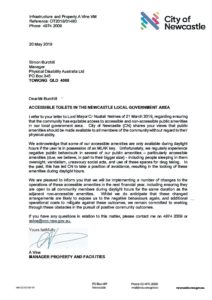
Letter-from-Office-for-Local-Government-11Oct19

 1800 732 674


