 1800 732 674


By Suzanne Gearing, CEO of Physical Disability Australia
In this blog, our CEO Suzanne Gearing uses humour to highlight a serious issue affecting people with mobility aids and others with mobility and access requirements.
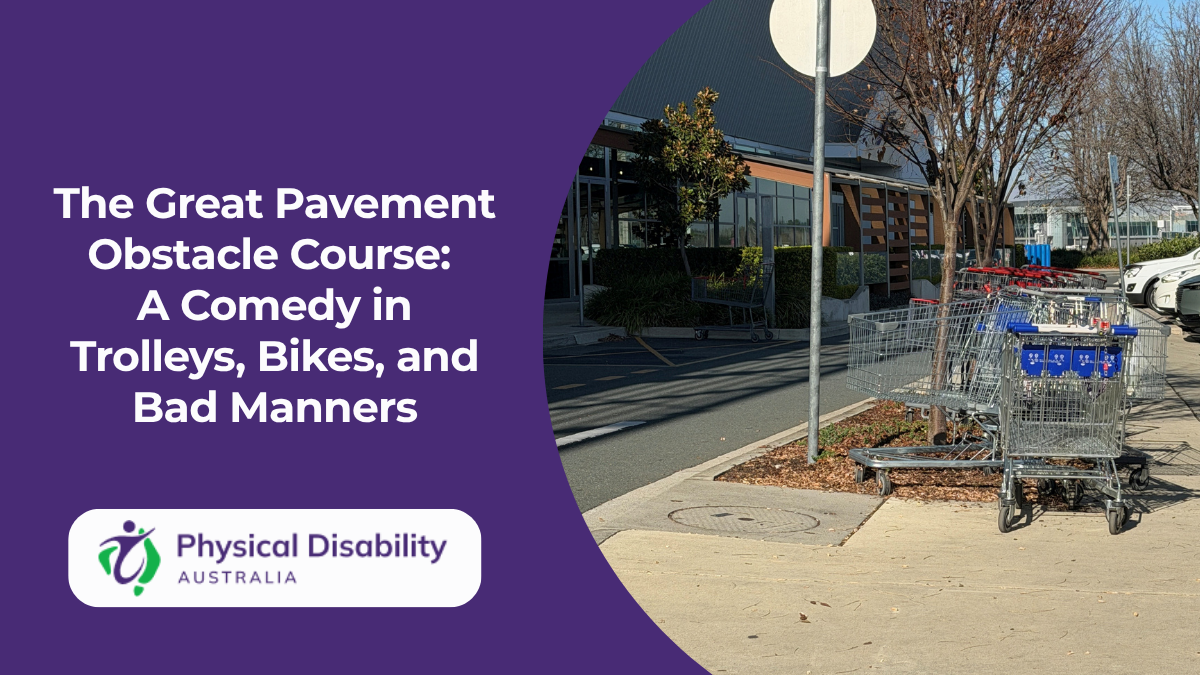
Every footpath seems to have developed a serious attitude problem. One minute it is a public pathway, the next it is a chaotic storage unit for shopping trolleys, e-bikes, scooters, bins, and whatever else has been abandoned by someone who decided the middle of the pavement was a perfectly reasonable parking space. The result is a scene that looks less like a walkway and more like an obstacle course designed by a committee with a grudge.
For most pedestrians, cluttered footpaths are annoying. You mutter, you step around the mess, maybe you do a dramatic little sidestep and continue with your day. For people in wheelchairs, though, the experience is very different. A blocked footpath can mean detouring onto the road, getting stuck, struggling to turn around, or simply not being able to pass at all. What looks like a minor nuisance to one person can become a complete barrier to another.
That is the part many people miss. A shopping trolley left in the wrong place is not just a shopping trolley. It is a gate. An e-bike dumped sideways across the path is not just sloppy parking. It is a wall. A scooter leaning dramatically against a pole is not street art. It is an access problem. Public space only works when it is actually public, and that means everyone can use it without needing to perform a physics experiment first.
The strange thing is how confident these obstacles look. The trolley is parked at a jaunty angle, as if it is posing for a lifestyle magazine cover titled Urban Chaos Weekly. The e-bike sprawls across the pavement with the relaxed energy of someone who has absolutely no intention of moving. The scooter looks like it has been placed there by a person who thought, “Surely this is fine,” just before vanishing into a café. Meanwhile, a wheelchair user approaches the scene like a general surveying a battlefield, calculating angles, widths, bumps, and the emotional strength required to attempt the crossing.
There is a special kind of irony in this. A footpath is literally a place for feet … or in some cases wheels, canes, prams, and mobility aids … yet it is often treated as the one area where thought is optional. People will carefully park a car, align a bike in a rack, and neatly return a shopping cart indoors, but somehow the pavement becomes the wild west. The message seems to be: Not my problem, I’m only here for a minute. That “minute” can be someone else’s entire journey.
People with mobility aids already deal with enough without having to battle everyday clutter. They navigate uneven surfaces, dropped kerbs, narrow doorways, weather, curbs, and the occasional tiny slope that behaves like a mountain. Add a line of abandoned trolleys and a bike that has collapsed in protest, and a simple trip to the shop becomes a test of patience, endurance, and creativity. It is hard to feel cheerful about freedom of movement when your route has been turned into a scavenger hunt for a clear patch of pavement.
And yet, there is a simple fix. Keep the path clear. That is it. No grand policy speech, no heroic effort, no complicated technology. Just basic courtesy and an understanding that footpaths are not private storage shelves. If you are borrowing a public space to leave your trolley, bike, or scooter, you are also borrowing someone else’s independence, even if only for a moment.
There is also a bigger point hidden inside the clutter. Accessibility is not only about ramps and handrails and official signs. It is also about everyday behaviour. It is about whether people think before blocking a route. It is about whether public space is treated as shared space. It is about whether access is real in practice, not just on paper.
So the next time you see a trolley parked like a tiny metal roadblock or an e-bike sprawled across the footpath with all the grace of a fainted giraffe, remember this: someone else may not be able to step around it, because stepping around is not always an option. A clear footpath is not a luxury. It is a basic part of making a town or city usable for everyone.
Keeping footpaths clear is a simple act that can make a meaningful difference. Before leaving anything on a footpath, take a moment to consider whether a wheelchair user or someone using a mobility aid can pass safely.
Have footpath obstructions affected your access or independence? PDA welcomes stories from people with physical disability. Sharing your experience can help raise awareness and support our advocacy for more accessible communities.
Share your story with PDA:
https://www.pda.org.au/share-your-story/
You can also strengthen PDA’s collective voice by becoming a member. Membership is free:


